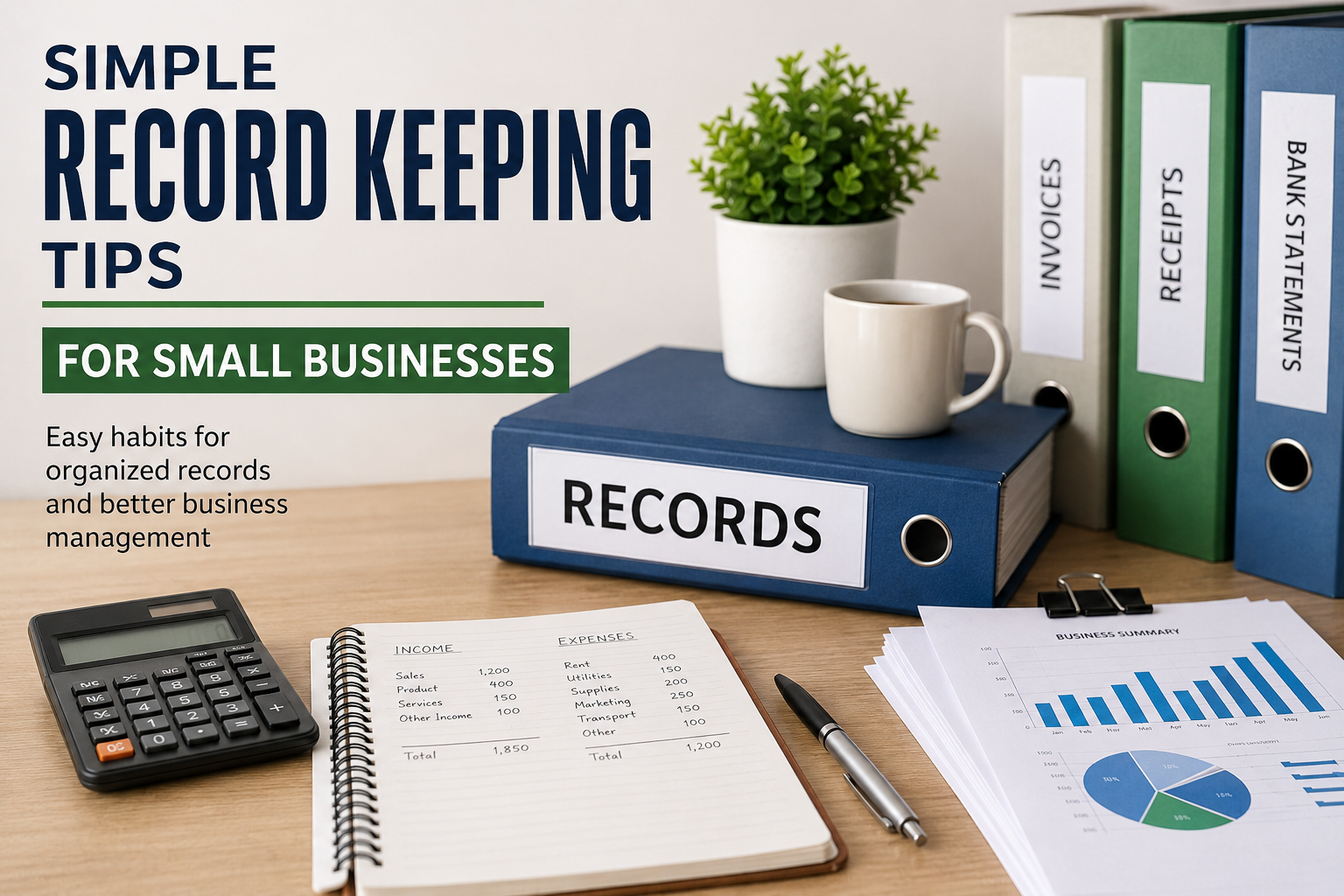
When I first started learning about small business management, I thought record keeping was one of those boring tasks that could be done whenever I had free time. Later, I realized that good records are actually one of the most important parts of running a business. If I do not know how much money is coming in, how much I am spending, what customers owe me, or what I have already paid, it becomes difficult to make good decisions.
For a small business owner, record keeping does not have to be complicated. I believe the best system is one that is simple enough to use every day. In this article, I want to share some simple record keeping tips that can help small business owners stay organized, save time, and understand their business finances better.
Keep Business and Personal Records Separate
One of the first things I recommend is keeping business records separate from personal records. When personal and business expenses are mixed together, it becomes difficult to understand the real financial condition of the business.
For example, if I use the same bank account for groceries, household bills, business purchases, and customer payments, I may spend a lot of time trying to figure out which transactions belong to the business.
Having a separate business bank account can make things much easier. I can see business income and expenses more clearly, and it also makes financial reports easier to prepare.
Even if the business is very small, creating a clear separation between personal and business money is a useful habit.
Record Every Business Transaction
Another important habit is recording every business transaction. I do not think small transactions should be ignored just because they seem unimportant.
A small purchase of office supplies may not seem like a big expense. However, when many small purchases are added together, they can become a significant amount of money.
I recommend recording sales, purchases, subscriptions, transportation costs, advertising expenses, equipment purchases, and other business related transactions.
The record does not have to be complicated. The date, description, amount, and payment method may be enough for a simple record system.
The main goal is to avoid depending on memory.
Save Your Receipts
Receipts are easy to lose, especially when I am busy. However, keeping receipts is an important part of good record keeping.
Whenever I purchase something for my business, I try to keep proof of the transaction. Depending on the type of business, receipts may be useful for accounting, budgeting, expense tracking, returns, or tax preparation.
Today, many receipts are digital, so I can create a folder on my computer or cloud storage and save them there. For paper receipts, taking a clear photo can also be helpful.
I recommend organizing receipts by month or category. This makes it much easier to find a specific receipt later.
Use a Simple Accounting System
I believe small businesses should use an accounting system that matches their actual needs. A beginner does not necessarily need a complicated system with dozens of features.
For a very small business, a properly organized spreadsheet may be enough at the beginning. As the business grows, accounting software can make the process easier.
The important thing is consistency. A simple system that I update regularly is much better than an advanced system that I do not understand or use.
My advice is to start simple and improve the system as the business becomes more complex.
Track Your Income
Knowing how much money the business earns is essential. I recommend keeping a clear record of every sale or payment received.
For each transaction, I can record the date, customer or source, amount, invoice number if applicable, and payment method.
This helps me understand which products or services are generating the most revenue. It can also help me identify periods when sales are strong or weak.
When income is properly recorded, it becomes easier to compare actual performance with business goals.
Track Your Expenses
Income tells me how much money the business receives, but expenses tell me how much it costs to operate.
I recommend creating basic expense categories. These might include rent, internet, advertising, software, supplies, transportation, equipment, employee payments, and professional services.
Categorizing expenses helps me understand where the money is going.
For example, if advertising expenses continue increasing but sales are not improving, I may need to reconsider my marketing strategy.
Good expense records can therefore help with more than accounting. They can also support better business decisions.
Keep Customer Payment Records
If a business sells products or services on credit, customer payment records become especially important.
I recommend keeping track of invoices, payment dates, outstanding amounts, and payment status.
Without a proper record, it is easy to forget that a customer still owes money. This can create cash flow problems for a small business.
A simple list can show which invoices have been paid and which ones are still outstanding. I can then follow up with customers when necessary.
Keep Supplier Records
Businesses also need to keep track of the people and companies they purchase from.
I recommend maintaining basic supplier information, including contact details, invoices, payment dates, and amounts paid.
This can help when I need to check a previous purchase, request a replacement, compare prices, or review spending.
Supplier records can also help me identify which suppliers are costing the business the most money.
Set a Regular Record Keeping Schedule
One mistake I think many small business owners make is waiting until the end of the month to organize everything.
When transactions are left for too long, the work becomes stressful. I prefer to make record keeping a regular habit.
For example, I might spend a few minutes each day recording important transactions. Then, once a week, I can review the records and make sure nothing is missing.
This approach is much easier than trying to remember an entire month’s activity at once.
Organize Digital Files Properly
Digital files can quickly become confusing if they are not organized.
I recommend creating simple folders for invoices, receipts, bank statements, expenses, sales records, and other important documents.
I also believe file names should be clear. Instead of saving a file with a random name, I can use a name that includes the date and document type.
For example, a file could be named August 2026 Office Supplies Receipt. This makes searching much easier later.
Back Up Your Records
Good records are only useful if they are safe.
I recommend keeping backups of important business documents. A computer can fail, a phone can be lost, or files can accidentally be deleted.
Cloud storage can provide an additional layer of protection. An external storage device can also be useful as another backup option.
I would not depend on only one copy of important business records.
Review Records Regularly
Record keeping should not stop after entering information. I believe regular reviews are just as important.
At the end of each week or month, I can review income, expenses, unpaid invoices, and other important information.
This gives me a clearer picture of how the business is performing.
Regular reviews can also help me find mistakes. For example, I may discover a duplicate expense, a missing payment, or an invoice that was never followed up.
Finding these problems early is much easier than discovering them months later.
Keep Records for the Required Period
Different countries and business structures can have different requirements for keeping financial records. Because of this, I would not recommend throwing away important documents without checking the rules that apply to the business.
Tax records, invoices, receipts, payroll information, and financial statements may need to be retained for specific periods.
When I am unsure about a legal or tax requirement, I believe it is better to ask a qualified accountant or relevant authority instead of guessing.
Do Not Wait Until Tax Time
One of the biggest benefits of good record keeping is making tax preparation easier.
If I wait until tax season to organize receipts and financial information, I may spend many stressful hours trying to reconstruct old transactions.
When records are updated throughout the year, the information is already available when it is needed.
It can also make it easier for an accountant or tax professional to understand the business finances.
Make Record Keeping Part of the Business Routine
In my opinion, the biggest secret to simple record keeping is consistency.
I do not need to spend several hours every day organizing financial information. Instead, I can create a routine that takes a small amount of time.
For example, I can record transactions during the day, organize receipts once a week, and review financial information at the end of each month.
Once this becomes a habit, record keeping feels less like a separate job and more like a normal part of running the business.
Final Thoughts
Simple record keeping can make a big difference for a small business. I have found that staying organized gives me a better understanding of where money is coming from and where it is going.
The most useful habits are not necessarily complicated. Keeping business and personal records separate, recording every transaction, saving receipts, tracking income and expenses, organizing digital files, backing up important documents, and reviewing records regularly can create a strong foundation.
I believe small business owners should focus on creating a system they can actually maintain. There is no benefit in creating a complicated record keeping process that becomes difficult to follow.
Start with the basics and improve the system as the business grows. When financial records are clear and organized, it becomes easier to make informed decisions, manage cash flow, prepare financial information, and build a more stable business.
For me, good record keeping is not simply about numbers. It is about knowing what is happening inside the business and having the information needed to move forward with confidence.